
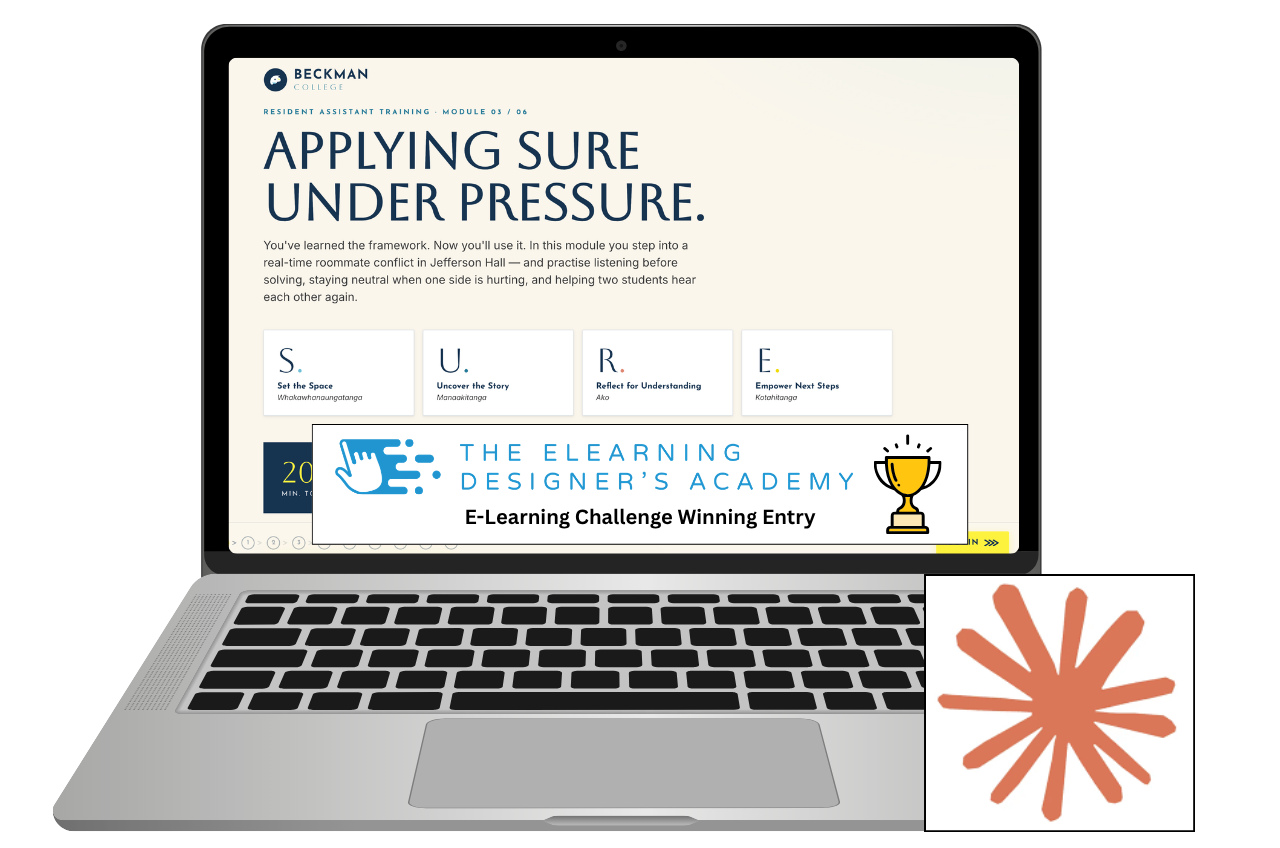
Vibe Coding:
Managing Conflict
This project is part of Tim Slade’s May 2026 Design Challenge, Vibe Coded eLearning with Claude Design.
The challenge is to revisit a previous e learning brief and reimagine part of it using Claude Design, creating a small but meaningful proof of concept rather than a full course. Instead of building screen by screen in a traditional authoring tool, the focus shifts to shaping the experience through intent, structure, prompts and iteration.
For this project, I am adapting the September 2024 challenge on managing college roommate conflicts and focusing on Module 3: Applying SURE Under Pressure.
In this module, Resident Assistants put previously learned mediation skills into practice in a realistic, emotionally charged scenario. My aim is to explore how Claude Design can be used to create an unfolding, decision based learning experience where the learner must build trust, stay neutral and keep the conversation open under pressure.
Brief

Target Learner
Beckman College Student Resident Assistants

My Role
Instructional Designer
Vibe coding workflow and creative direction
Tools Used
Google Docs (Design doc)
Google Slides (Storyboard)
Claude Design (Module Build)
ChatGPT (Image Generation)
HeyGen (Animated Avatars)
ElevenLabs (Voiceovers)

-
Beckman College is seeing a growing number of room change requests caused by unresolved roommate conflict. Resident Assistants are often brought in when tensions are already high, making it harder to build trust, uncover the real issue, and keep students engaged in the mediation process.
Although RAs receive training in conflict management, knowing the process is not the same as applying it under pressure. They need a safe space to practise responding to emotionally charged situations before facing them in real life.
-
I am designing Module 3: Applying SURE Under Pressure, a scenario based practice experience built entirely using Claude Design.
Learners step into the role of a Resident Assistant responding to a late night distress message from a student who feels ready to leave university. Through unfolding dialogue, environmental clues, digital artefacts and decision making moments, learners apply the SURE mediation framework in real time.
Rather than focusing on “right” or “wrong” answers, the experience is designed to show how small choices can influence trust, openness and whether the mediation process stays alive.
Design & Development
Design Document
Initial ideas, research notes and early thinking used to explore the problem, audience and potential learning approaches.
Storyboard
A visual blueprint of the learning experience, mapping the learner journey, interactions and key decision points before development.
Style Guide
A collection of visual, audio and design references used to establish the look, feel and overall direction of the project.

Behind the Build Series
From storyboard to prototype, this series captures the thinking, pivots and design decisions shaping the build in real time.
Episode 1: Introduction
Episode 2: Defining the Learning
Episode 3: Developing with Claude
Episode 4: The First Iteration
Episode 5: Māori Values and Concepts
Episode 6: The Vision:
Behind the Design
Reflection
Looking back, these are some of the thoughts that stuck with me throughout the build:
A clear vision mattered more than clever prompts.
Claude was strongest when refining specific elements rather than generating complete solutions.
The first version was functional. The later iterations made it human.
Simplifying content was often harder than creating it.
Token limits were frustrating, but sometimes helped slow down decision-making.
Human judgement remained the most important design tool throughout the project.
The final iteration came much closer to my original vision than I expected.